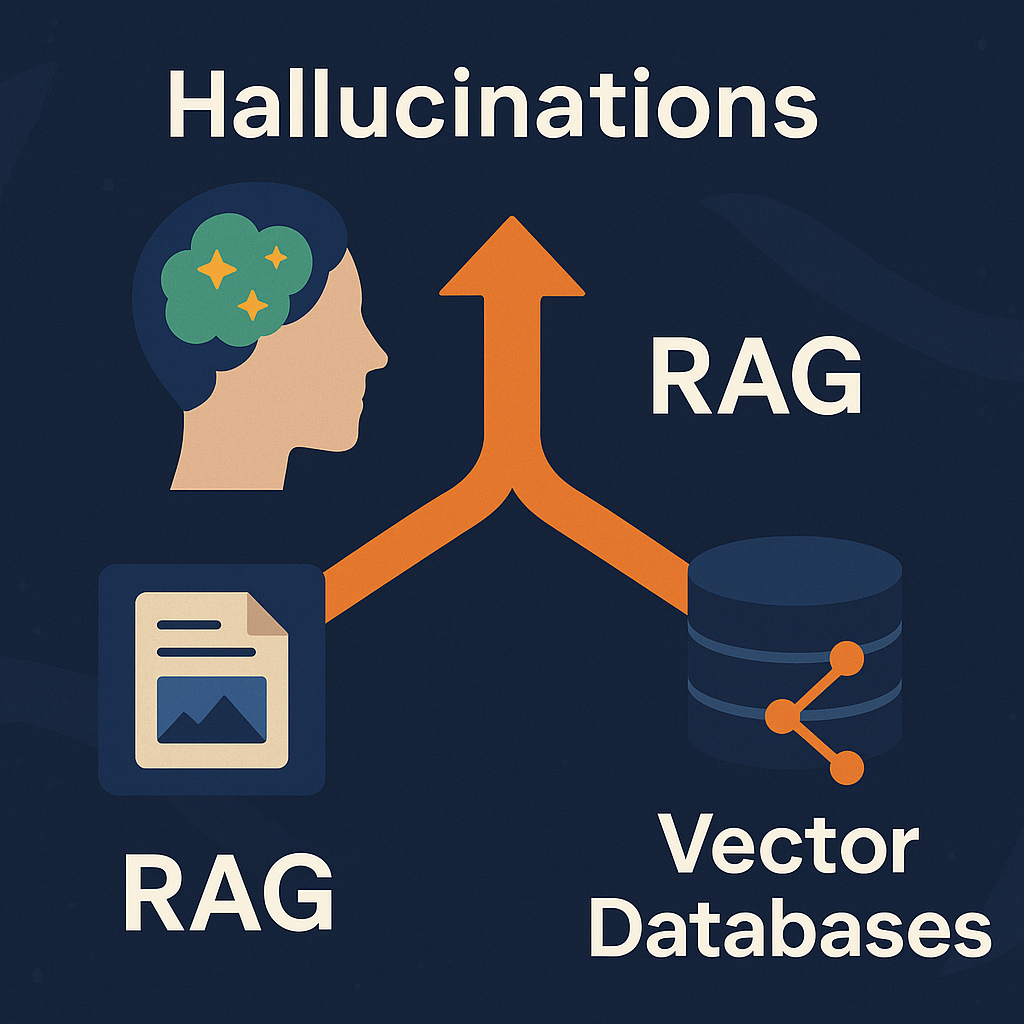
Hallucinations - RAG - Vector databases
Hallucinations in AI are false outputs. RAG uses vector databases and semantic search to deliver accurate, grounded AI responses.
Hallucinations, RAG, and Vector Databases: Demystifying AI's Brain
In the world of AI, hallucinations refer to instances where a model generates outputs that are fluent and confident but factually incorrect or nonsensical. These errors arise because large language models (LLMs) like GPT are trained to predict text based on patterns, not verified knowledge. To address this, the concept of Retrieval-Augmented Generation (RAG) has emerged.
RAG combines the power of language models with real-time access to trusted external data. Instead of relying solely on the model’s pre-trained knowledge, RAG allows it to “retrieve” relevant facts from a connected knowledge base, dramatically reducing hallucinations and improving factual accuracy.
This is where vector databases come in. Unlike traditional databases, vector databases store and retrieve information based on meaning, using embeddings—numerical representations of text. When a user queries an AI system, the query is converted into a vector, and the vector database finds semantically similar documents to feed into the language model.
Together, RAG and vector databases create a more reliable and context-aware AI system. This architecture empowers LLMs to provide answers grounded in external knowledge, helping mitigate hallucinations, enhance trustworthiness, and enable smarter applications in customer support, legal, healthcare, and other fields.
- Audience
- Everyday with interested learning better
- Publisher
- BSL